The point is slipping away. Your partner is at the net, you are stuck behind them, and a soft ball lands in the middle. Both of you reach for it. Nobody gets there. That is not a racket-skill problem – it is a positioning problem, and it is exactly where smart padel doubles tactics beginners can use make the game more fun, fast and furious.
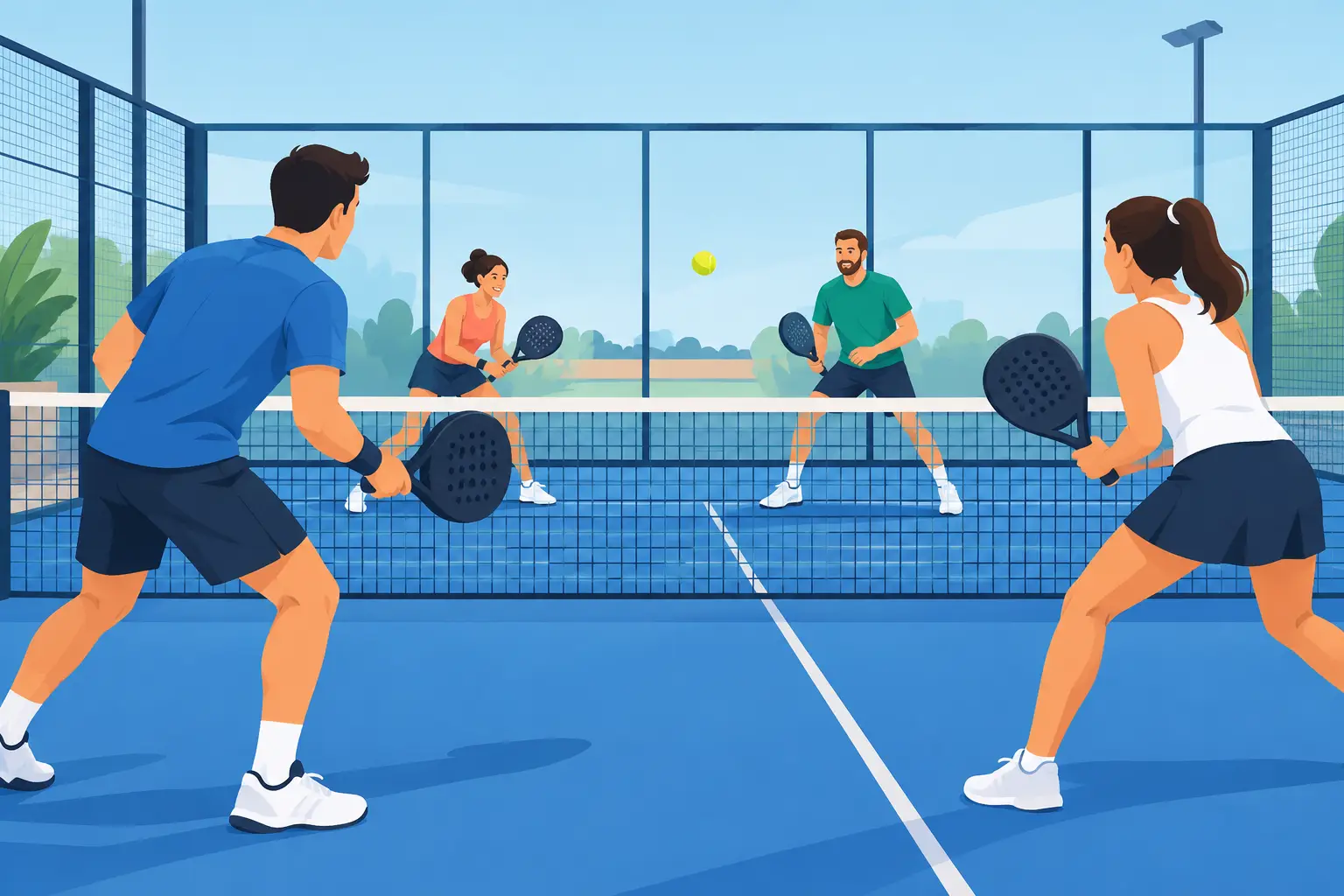
Padel is not singles tennis inside a glass box. It is a team sport played in a tight space, where two players moving as one unit will usually beat two players chasing every ball on their own. You do not need a huge smash or a highlight-reel winner to improve quickly. You need clear roles, patient shot selection and a partner you can communicate with.
Start by owning your half of the court
The first rule is simple: stay connected to your partner. Imagine a rope between you both. When one player moves forward, the other moves forward. When one shifts left, the other shifts left. You are not guarding fixed squares of court while your partner does their own thing. You are protecting space together.
At the net, stand roughly an arm-and-a-half apart. That leaves you close enough to cover the middle but wide enough to handle a ball played towards the side fence. When defending near the back glass, keep a similar shape. If the ball travels cross-court, both players can shade in that direction. If it goes down the line, recover together.
Beginners often leave a giant gap through the middle because they are worried about getting beaten down the sideline. In doubles, the middle is usually the higher-percentage target for opponents, especially when they see hesitation. Protect it with active communication rather than standing shoulder to shoulder all rally.
Call the middle ball early
Agree on one basic system before you play. The forehand player takes the middle ball whenever possible is a great starting point. For example, if the ball is between a right-handed player on the left and a left-handed player on the right, both may have a forehand available. Whoever calls it first plays it. No call means the forehand player goes.
Use short, loud calls: “mine”, “yours”, “leave”, “switch” and “up”. This may feel obvious at first, but clear talk removes the half-second of doubt that costs points. Give your partner encouragement after mistakes too. A quick “good idea” keeps the next ball in play far better than silence or frustration.
Win the net, but earn your way there
The team controlling the net has the advantage in padel. From there, you can volley down into the court, angle the ball, pressure opponents and make their next shot harder. But charging forward after every shot is not the answer.
Move up when you have played a ball that gives you time: a deep return, a high defensive lob, or a solid shot that keeps the opposition at the back. Move together and stop around a step or two behind the net, rather than crowding it. Standing too close makes you vulnerable to a simple lob over your head.
If your team is defending at the back, your first mission is often to win the net back with a lob. Aim high and deep over the opponent with the easier overhead, usually the player who looks less comfortable or is slightly out of position. Then advance together while watching their reply.
There is a trade-off. A low, flat ball can force an error if your opponents are under pressure, but it can also sit up for an easy volley. A lob gives away initiative if it lands short. For new players, height and depth are safer than trying to thread a perfect winner.
Your first padel doubles tactics for the return of serve
The return of serve sets the point up, so avoid treating it as a chance to hit hard. Get the ball back deep, preferably low, and look for your next opportunity to take the net. A controlled cross-court return is often the safest option because the court is longer on the diagonal and the net is lower in the middle.
After returning, do not automatically sprint forward. If your return is short or floats up, stay back with your partner and prepare for the volley. If it is deep and controlled, move in together. This one decision will save a lot of beginner points.
On serve, the server should usually follow the ball to the net. Their partner starts closer to the net and watches for the return. Keep the serve reliable and low rather than chasing aces. A strong serve in padel is one that prevents an aggressive return and lets your team establish position.
Let the glass help you, not rush you
The back glass can look chaotic until you learn one calming truth: you often have more time than you think. When a ball passes you and reaches the back wall, let it rebound instead of lunging at it immediately. Step back, track the bounce, and play it after the glass when the ball sits at a comfortable height.
A useful beginner pattern is to allow a deep ball to bounce, hit the back glass, then send a high lob cross-court. It resets the rally and gives your team a chance to move forward. You do not need to hit every ball before the wall.
Side glass is less predictable, particularly when the ball arrives with pace or spin. Until you are comfortable reading it, use a simpler option: make contact before the side wall where possible, or play a defensive ball towards the centre. The middle gives you more margin and reduces the chance of feeding an angle back to your opponents.
At The Padel Lounge, the indoor setting and high ceilings make it easier to practise these lobs without wind turning a good idea into a lost ball. Use early sessions to get familiar with the rebound rather than judging yourself by the scoreline.
Build points with patience at the net
From the net, beginners often make the same mistake: they volley harder because they think the point should end. In padel, a hard volley at waist height can rebound cleanly off the back glass and hand the opposition an easy shot. The smarter volley is usually controlled, low and placed.
Play down towards your opponents’ feet. Send the ball through the middle to create uncertainty. Use a gentle angled volley only when you have space and balance. If the ball is above net height, you can be more aggressive. If it is below net height, lift it safely and keep your position rather than forcing a winner.
The bandeja, a controlled overhead played with slice, will become valuable as you progress. For now, do not feel pressured to copy advanced players. When a lob pushes you back, the priority is to keep the ball in play and avoid losing the net completely. A calm overhead towards the middle is a quality decision.
Stop both players chasing the same shiny ball
There are moments when you must switch sides. If a lob forces one player back to retrieve an overhead, their partner should slide across and cover the open half. Call “switch”, play the ball, and recover as a pair. Do not switch for every ball, though. Constant crossing creates more confusion than it solves.
A simple guide works well: switch when one player has been pulled well out of their normal lane or runs behind their partner. Otherwise, recover to your original sides. The goal is not perfect symmetry. The goal is to avoid an empty court.
Watch your opponents for the same weakness. If they repeatedly both chase the middle, use it. If one player stays glued to the net while their partner defends alone, lob over the net player. Padel rewards the pair that notices patterns first.
Make the next match about one team habit
Trying to fix serves, volleys, lobs, glass work and positioning all at once is a fast way to feel overwhelmed. Choose one team focus before you step on court. It might be calling every middle ball, moving to the net together after a good lob, or using three controlled shots before attempting anything aggressive.
After the game, talk about what worked while the rallies are still fresh. Which balls caused confusion? When did you win the net? Did your lobs land deep enough? This is where social play becomes real development, without draining the fun out of it.
Your best beginner tactic is not a secret shot. It is becoming the pair that stays connected, talks early and gives every ball one more chance. Keep building that habit, point by point, and the court will start to feel much bigger.